Again What Was Found in the Area Set Aside for the Native People?
| Indian Territory | |||||||||
|---|---|---|---|---|---|---|---|---|---|
| Unincorporated and unorganized territory consisting of independent Native American nations of the Us | |||||||||
| 1834–1907 | |||||||||
| Flag (1822-1836) | |||||||||
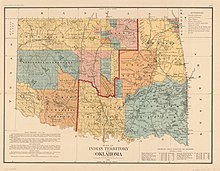 Oklahoma and Indian Territories, 1890 | |||||||||
| Uppercase | Fort Gibson (de facto) Tahlequah (Cherokee) Tuskahoma (Choctaw) Tishomingo (Chickasaw) Okmulgee (Creek) Wewoka (Seminole) Pawhuska (Osage) | ||||||||
| History | |||||||||
| • Type | Indian Tribal self-government | ||||||||
| History | |||||||||
| • Indian Intercourse Human activity | June xxx, 1834 | ||||||||
| • Platte Buy | 1836 | ||||||||
| • Kansas–Nebraska Act | May 30, 1854 | ||||||||
| • Oklahoma Territory separated | May ii, 1890 | ||||||||
| • Oklahoma statehood | Nov sixteen, 1907 | ||||||||
| |||||||||
| Today part of |
| ||||||||


The Indian Territory and the Indian Territories are terms that more often than not described an evolving country area set bated by the United States Regime for the relocation of Native Americans who held aboriginal title to their country as a sovereign contained state. In general, the tribes ceded land they occupied in exchange for land grants in 1803. The concept of an Indian Territory was an outcome of the The states federal authorities's 18th- and 19th-century policy of Indian removal. After the American Civil War (1861–1865), the policy of the US authorities was 1 of assimilation.
The term Indian Reserve describes lands the British set up aside for Indigenous tribes betwixt the Appalachian Mountains and the Mississippi River in the time before the American Revolutionary War (1775–1783).
Indian Territory later came to refer to an unorganized territory whose general borders were initially set by the Nonintercourse Act of 1834, and was the successor to the residuum of the Missouri Territory afterward Missouri received statehood. The borders of Indian Territory were reduced in size as diverse Organic Acts were passed by Congress to create incorporated territories of the United States. The 1907 Oklahoma Enabling Act created the single state of Oklahoma by combining Oklahoma Territory and Indian Territory, ending the existence of an unorganized unincorporated independent Indian Territory as such. Before Oklahoma statehood, Indian Territory from 1890 onwards consisted of the Cherokee, Choctaw, Chickasaw, Creek and Seminole tribes and their territorial holdings.
Indian reservations remain inside the boundaries of United states states, but largely exempt from state jurisdiction. The term Indian country is used to signify lands nether the control of Native nations, including Indian reservations, trust lands on Oklahoma Tribal Statistical Surface area, or, more casually, to depict anywhere large numbers of Native Americans live.
Clarification and geography [edit]

Indian Country 1834 (in Red)


Grayness's new map of Texas and Indian Territory (c. 1876)

Map of the gradual opening of Oklahoma Territory to white settlers and the Indian Territory, annexed by Oklahoma in 1907.


Indian Territory in 1885 (pinnacle) and 1891 (bottom). This latter expanse of 31,069 square miles would subsequently be annexed to the new state of Oklahoma in 1907.

Oklahoma and Indian Territories, 1890s
Indian Territory, also known as the Indian Territories and the Indian Country, was land inside the U.s. of America reserved for the forced re-settlement of Native Americans. Therefore, it was not a traditional territory for the tribes settled upon it.[1] The general borders were set by the Indian Intercourse Act of 1834. The territory was located in the Central United States.
While Congress passed several Organic Acts that provided a path for statehood for much of the original Indian Country, Congress never passed an Organic Deed for the Indian Territory. Indian Territory was never an organized incorporated territory of the Us. In general, tribes could not sell state to not-Indians (Johnson v. M'Intosh). Treaties with the tribes restricted entry of non-Indians into tribal areas; Indian tribes were largely self-governing, were suzerain nations, with established tribal governments and well established cultures. The region never had a formal regime until after the American Ceremonious War.
After the Civil State of war, the Southern Treaty Commission re-wrote treaties with tribes that sided with the Confederacy, reducing the territory of the Five Civilized Tribes and providing land to resettle Plains Indians and tribes of the Midwestern United States.[2] These re-written treaties included provisions for a territorial legislature with proportional representation from various tribes.
In time, the Indian Territory was reduced to what is at present Oklahoma. The Organic Act of 1890 reduced Indian Territory to the lands occupied by the 5 Civilized Tribes and the Tribes of the Quapaw Indian Agency (at the borders of Kansas and Missouri). The remaining western portion of the old Indian Territory became the Oklahoma Territory.
The Oklahoma organic act applied the laws of Nebraska to the incorporated territory of Oklahoma Territory, and the laws of Arkansas to the still unincorporated Indian Territory, since for years the federal U.S. District Court on the eastern borderline in Ft. Smith, Arkansas had criminal and civil jurisdiction over the Territory.
History [edit]
Indian Reserve and Louisiana Buy [edit]
The concept of an Indian territory is the successor to the British Indian Reserve, a British American territory established by the Royal Declaration of 1763 that set bated land for use by the Native American tribes. The proclamation limited the settlement of Europeans to lands east of the Appalachian Mountains. The territory remained active until the Treaty of Paris that ended the American Revolutionary War, and the land was ceded to the United states of america. The Indian Reserve was slowly reduced in size via treaties with the American colonists, and after the British defeat in the Revolutionary State of war, the Reserve was ignored by European American settlers who slowly expanded westward.
At the time of the American Revolutionary War, many Native American tribes had long-continuing relationships with the British, and were loyal to Great Uk, simply they had a less-developed relationship with the American colonists. After the defeat of the British in the state of war, the Americans twice invaded the Ohio Land and were twice defeated. They finally defeated the Indian Western Confederacy at the Battle of Fallen Timbers in 1794 and imposed the Treaty of Greenville, which ceded about of what is now Ohio, part of nowadays-solar day Indiana, and the lands that include present-day Chicago and Detroit, to the United States federal government.
The period after the American Revolutionary War was 1 of rapid western expansion. The areas occupied by Native Americans in the United States were called Indian land. They were distinguished from "unorganized territory" because the areas were established by treaty.

The Louisiana Purchase was ane of several historical territorial additions to the United States.
In 1803 the United States of America agreed to purchase France'due south merits to French Louisiana for a total of $15 one thousand thousand (less than 3 cents per acre).[3]
President Thomas Jefferson doubted the legality of the buy. However, the chief negotiator, Robert R. Livingston believed that the third article of the treaty providing for the Louisiana Buy would be acceptable to Congress. The tertiary article stated, in part:[4]
the inhabitants of the ceded territory shall be incorporated in the Union of the United states of america, and admitted as soon as possible, according to the principles of the Federal Constitution, to the enjoyment of all the rights, advantages, and immunities of citizens of the U.s.a.; and in the meantime they shall exist maintained and protected in the complimentary enjoyment of their liberty, property, and the religion which they profess.
—viii Stat. at Fifty. 202
This committed the US regime to "the ultimate, but non to the immediate, admission" of the territory as multiple states, and "postponed its incorporation into the Union to the pleasure of Congress".[iv]
After the Louisiana Purchase in 1803, President Thomas Jefferson and his successors viewed much of the land due west of the Mississippi River as a place to resettle the Native Americans, so that white settlers would be gratuitous to alive in the lands east of the river. Indian removal became the official policy of the United States government with the passage of the 1830 Indian Removal Act, formulated by President Andrew Jackson.

When Louisiana became a state in 1812, the remaining territory was renamed Missouri Territory to avoid confusion. Arkansas Territory, which included the present Land of Arkansas plus most of the country of Oklahoma, was created out of the southern part of Missouri Territory in 1819. Originally the western border of Missouri was intended to extend due south all the way to the Red River, just n of Louisiana.[ description needed ] Withal, during negotiations with the Choctaw in 1820 for the Treaty of Doak's Stand up, Andrew Jackson ceded more of Arkansas Territory to the Choctaw than he realized, from what is now Oklahoma into Arkansas, east of Ft. Smith, Arkansas.[five] The General Survey Act of 1824 allowed a survey that established the western border of Arkansas Territory 45 miles west of Ft. Smith. But this was where the Choctaw and Cherokee tribes had just begun to settle, and the 2 nations objected strongly. In 1828 a new survey redefined the western Arkansas border just west of Ft. Smith.[6] After these redefinitions, the "Indian zone" would encompass the present states of Oklahoma, Kansas, Nebraska and part of Iowa.[vii]
Relocation and treaties [edit]

Map of Indian territory 1836
Earlier the 1871 Indian Appropriations Act, much of what was called Indian Territory was a big area in the central part of the United states of america whose boundaries were fix by treaties between the US Government and various indigenous tribes. Subsequently 1871, the Federal Regime dealt with Indian Tribes through statute; the 1871 Indian Appropriations Act also stated that "hereafter no Indian nation or tribe within the territory of the United States shall be acknowledged or recognized every bit an independent nation, tribe, or power with whom the United States may contract past treaty: Provided, further, That zip herein contained shall be construed to invalidate or impair the obligation of whatever treaty heretofore lawfully made and ratified with any such Indian nation or tribe".[viii] [9] [10] [11]
The Indian Appropriations Act likewise made it a federal criminal offence to commit murder, manslaughter, rape, assault with intent to kill, arson, burglary, or larceny inside any Territory of the U.s.a.. The Supreme Court affirmed the action in 1886 in Us v. Kagama, which affirmed that the US Government has plenary power over Native American tribes inside its borders using the rationalization that "The ability of the general government over these remnants of a race once powerful ... is necessary to their protection equally well as to the safety of those among whom they dwell".[12] While the federal regime of the United states of america had previously recognized the Indian Tribes as semi-independent, "information technology has the right and authority, instead of controlling them past treaties, to govern them by acts of Congress, they being within the geographical limit of the United States ... The Indians [Native Americans] owe no allegiance to a Land within which their reservation may be established, and the State gives them no protection."[xiii]
Reductions of area [edit]
White settlers connected to flood into Indian country. As the population increased, the homesteaders could petition Congress for cosmos of a territory. This would initiate an Organic Act, which established a three-part territorial regime. The governor and judiciary were appointed by the President of the U.s.a., while the legislature was elected by citizens residing in the territory. 1 elected representative was allowed a seat in the U. South. House of Representatives. The federal government took responsibility for territorial affairs. Later, the inhabitants of the territory could apply for admission equally a full state. No such action was taken for the so-called Indian Territory, then that area was non treated every bit a legal territory.[7]
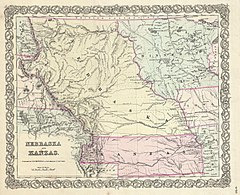
Kansas, Nebraska, Minnesota Territories 1855
The reduction of the country area of Indian Territory (or Indian Country, every bit defined in the Indian Intercourse Act of 1834), the successor of Missouri Territory began most immediately subsequently its creation with:
- Wisconsin Territory formed in 1836 from lands east of the Mississippi and between the Mississippi and Missouri rivers. Wisconsin became a country in 1848
- Iowa Territory (land between the Mississippi and Missouri Rivers) was separate from Wisconsin Territory in 1838 and became a land in 1846.
- Minnesota Territory was split from Iowa Territory in 1849 and part of the Minnesota Territory became the land of Minnesota in 1858
- Iowa Territory (land between the Mississippi and Missouri Rivers) was separate from Wisconsin Territory in 1838 and became a land in 1846.
- Dakota Territory was organized in 1861 from the northern function of Indian Country and Minnesota Territory. The name refers to the Dakota branch of the Sioux tribes.
- North Dakota and S Dakota became separate states simultaneously in 1889.
- Nowadays-day states of Montana and Wyoming were also part of the original Dakota Territory
Indian Country was reduced to the judge boundaries of the current state of Oklahoma past the Kansas–Nebraska Act of 1854, which created Kansas Territory and Nebraska Territory. The primal boundaries of the territories were:
- 40° N the current Kansas–Nebraska border
- 37° N the current Kansas–Oklahoma (Indian Territory) border
Kansas became a state in 1861, and Nebraska became a land in 1867. In 1890 the Oklahoma Organic Human activity created Oklahoma Territory out of the western role of Indian Territory, in anticipation of albeit both Indian Territory and Oklahoma Territory every bit a hereafter unmarried State of Oklahoma.
Civil War and Reconstruction [edit]
At the beginning of the Civil State of war, Indian Territory had been essentially reduced to the boundaries of the nowadays-mean solar day U.Southward. state of Oklahoma, and the primary residents of the territory were members of the Five Civilized Tribes or Plains tribes that had been relocated to the western function of the territory on state leased from the Five Civilized Tribes. In 1861, the U.Southward. abandoned Fort Washita, leaving the Chickasaw and Choctaw Nations defenseless against the Plains tribes. Later the same yr, the Confederate States of America signed a Treaty with Choctaws and Chickasaws. Ultimately, the Five Civilized Tribes and other tribes that had been relocated to the area, signed treaties of friendship with the Confederacy.
During the Civil War, Congress gave the U.S. president the authorisation to, if a tribe was "in a state of bodily hostility to the government of the Us... and, past annunciation, to declare all treaties with such tribe to be abrogated by such tribe"(25 USC Sec. 72). [14]
Members of the Five Civilized Tribes, and others who had relocated to the Oklahoma department of Indian Territory, fought primarily on the side of the Confederacy during the American Civil War in Indian territory. Brigadier General Stand Watie, a Confederate commander of the Cherokee Nation, became the last Amalgamated full general to surrender in the American Civil War, about the customs of Doaksville on June 23, 1865. The Reconstruction Treaties signed at the terminate of the Civil State of war fundamentally changed the human relationship between the tribes and the U.South. regime.
The Reconstruction era played out differently in Indian Territory and for Native Americans than for the remainder of the state. In 1862, Congress passed a law that immune the president, by proclamation, to cancel treaties with Indian Nations siding with the Confederacy (25 USC 72).[fifteen] The U.s.a. Business firm Committee on Territories (created in 1825) was examining the effectiveness of the policy of Indian removal, which was after the war considered to exist of limited effectiveness. It was decided that a new policy of Assimilation would be implemented. To implement the new policy, the Southern Treaty Commission was created by Congress to write new treaties with the Tribes siding with the Confederacy.
After the Ceremonious War the Southern Treaty Commission re-wrote treaties with tribes that sided with the Confederacy, reducing the territory of the Five Civilized Tribes and providing land to resettle Plains Native Americans and tribes of the mid-west.[16] General components of replacement treaties signed in 1866 include:[17]
- Abolitionism of slavery
- Amnesty for siding with Amalgamated States of America
- Agreement to legislation that Congress and the President "may deem necessary for the improve administration of justice and the protection of the rights of person and property inside the Indian territory."
- That the tribes grant correct of way for runway roads authorized by Congress; A land patent, or "outset-title deed" to alternate sections of land adjacent to rail roads would be granted to the rail road upon completion of each 20 mile section of track and water stations
- That inside each county, a quarter section of land be held in trust for the establishment of seats of justice therein, and also as many quarter-sections every bit the said legislative councils may deem proper for the permanent endowment of schools
- Provision for each man, woman, and child to receive 160 acres of land every bit an allotment. (The allotment policy was later codification on a national basis through the passage of The Dawes Human action, also chosen Full general Allotment Act, or Dawes Severalty Deed of 1887)
- That a country patent, or "first-title act" be issued equally show of allotment, "issued by the President of the U.s., and countersigned by the master executive officer of the nation in which the land lies"
- That treaties and parts of treaties inconsistent with the replacement treaties to exist zippo and void.
Ane component of assimilation would exist the distribution of holding held in-common by the tribe to private members of the tribe.[18]
The Medicine Lodge Treaty is the overall proper noun given to three treaties signed in Medicine Lodge, Kansas between the US regime and southern Plains Indian tribes who would ultimately reside in the western part of Indian Territory (ultimately Oklahoma Territory). The first treaty was signed October 21, 1867, with the Kiowa and Comanche tribes.[xix] The second, with the Plains Apache, was signed the same 24-hour interval.[20] The third treaty was signed with the Southern Cheyenne and Arapaho on Oct 28.[21]
Another component of assimilation was homesteading. The Homestead Human activity of 1862 was signed into law by President Abraham Lincoln. The Deed gave an applicant freehold title to an area chosen a "homestead" – typically 160 acres (65 hectares or one-quaternary section) of undeveloped federal state. Within Indian Territory, equally lands were removed from communal tribal ownership, a land patent (or beginning-championship deed) was given to tribal members. The remaining land was sold on a first-come basis, typically by land run, with settlers also receiving a land patent type deed. For these now former Indian lands, the General Land Part distributed the sales funds to the various tribal entities, according to previously negotiated terms.
Oklahoma Territory, end of territories upon statehood [edit]
| Year | Popular. | ±% |
|---|---|---|
| 1890 | 180,182 | — |
| 1900 | 392,060 | +117.6% |
| Source: 1890–1900[22] | ||
The Oklahoma organic deed of 1890 created an organized incorporated territory of the United States of Oklahoma Territory, with the intent of combining the Oklahoma and Indian territories into a unmarried State of Oklahoma. The citizens of Indian Territory tried, in 1905, to proceeds admission to the wedlock as the Land of Sequoyah, simply were rebuffed by Congress and an Assistants which did non want two new Western states, Sequoyah and Oklahoma. Theodore Roosevelt and then proposed a compromise that would join Indian Territory with Oklahoma Territory to course a single country. This resulted in passage of the Oklahoma Enabling Human action, which President Roosevelt signed June 16, 1906.[23] empowered the people residing in Indian Territory and Oklahoma Territory to elect delegates to a state ramble convention and subsequently to be admitted to the spousal relationship as a unmarried country. Citizens then joined to seek admission of a single state to the Union. With Oklahoma statehood in November 1907, Indian Territory lost its "independence" and was extinguished.
Tribes [edit]
Tribes indigenous to Oklahoma [edit]

Ii Wichita women in summer clothes, 1870
Indian Territory marks the confluence of the Southern Plains and Southeastern Woodlands cultural regions. Its western region is part of the Nifty Plains, subjected to extended periods of drought and high winds, and the Ozark Plateau is to the east in a boiling subtropical climate zone. Tribes ethnic to the present day state of Oklahoma include both agrarian and hunter-gatherer tribes. The arrival of horses with the Castilian in the 16th century ushered in equus caballus culture-era, when tribes could adopt a nomadic lifestyle and follow arable bison herds.


The Southern Plains villagers, an archaeological culture that flourished from 800 to 1500 CE, lived in semi-sedentary villages throughout the western part of Indian Territory, where they farmed maize and hunted buffalo. They are likely ancestors of the Wichita and Affiliated Tribes. The ancestors of the Wichita have lived in the eastern Great Plains from the Red River north to Nebraska for at least 2,000 years.[24] The early Wichita people were hunters and gatherers who gradually adopted agronomics. By about 900 CE, farming villages began to appear on terraces above the Washita River and Southward Canadian River in Oklahoma.
Fellow member tribes of the Caddo Confederacy lived in the eastern part of Indian Territory and are ancestors of the Caddo Nation. The Caddo people speak a Caddoan language and is a confederation of several tribes who traditionally inhabited much of what is now Due east Texas, northern Louisiana and portions of southern Arkansas and Oklahoma. The tribe was one time part of the Caddoan Mississippian culture and thought to exist an extension of woodland flow peoples who started inhabiting the area around 200 BCE. In an 1835 Treaty [25] made at the agency-firm in the Caddo nation and Country of Louisiana, the Caddo Nation sold their tribal lands to the U.s.. In 1846 the Caddo along with several other tribes signed a treaty that fabricated the Caddo a protectorate of the U.s.a. and established framework of a legal arrangement between the Caddo and the US.[26] Tribal headquarters are in Binger, Oklahoma.
The Wichita and Caddo both spoke Caddoan languages, as did the Kichai people, who were too ethnic to what is now Oklahoma and ultimately became part of the Wichita and Affiliated Tribes. The Wichita (and other tribes) signed a treaty of friendship with the US in 1835.[27] The tribe's headquarters are in Anadarko, Oklahoma.
In the 18th century, prior to Indian Removal (the forced relocation by the United states federal regime) Kiowa, Apache, and Comanche people entered into Indian Territory from the westward, and the Quapaw and Osage entered from the east. During Indian Removal of the 19th century, additional tribes received their state either by treaty via land grant from the federal government of the The states or they purchased the state receiving fee simple recorded title.
Tribes from the Southeastern Woodlands [edit]

The Mississippian culture was a mound-building Native American culture that flourished in Due north America earlier the arrival of Europeans.
Many of the tribes forcibly relocated to Indian Territory were from Southeastern U.s.a., including the so-called Five Civilized Tribes or Cherokee, Chickasaw, Choctaw, Muscogee Creeks, and Seminole, but also the Natchez, Yuchi, Alabama, Koasati, and Caddo people.

Between 1814 and 1840, the 5 Civilized Tribes had gradually ceded most of their lands in the Southeast section of the US through a serial of treaties. The southern part of Indian Country (what somewhen became the State of Oklahoma) served as the destination for the policy of Indian removal, a policy pursued intermittently by American presidents early in the 19th century, but aggressively pursued past President Andrew Jackson after the passage of the Indian Removal Act of 1830. The Five Civilized Tribes in the South were the most prominent tribes displaced past the policy, a relocation that came to be known as the Trail of Tears during the Choctaw removals starting in 1831. The trail ended in what is at present Arkansas and Oklahoma, where there were already many Indians living in the territory, besides as whites and escaped slaves. Other tribes, such as the Delaware, Cheyenne, and Apache were also forced to relocate to the Indian territory.

The historic Choctaw Capitol in Tuskahoma.
The V Civilized Tribes established tribal capitals in the following towns:
- Cherokee Nation – Tahlequah
- Chickasaw Nation – Tishomingo
- Choctaw Nation – Tuskahoma (later moved to Durant)
- Creek Nation – Okmulgee
- Seminole Nation – Wewoka
These tribes founded towns such as Tulsa, Ardmore, Muskogee, which became some of the larger towns in the state. They as well brought their African slaves to Oklahoma, which added to the African American population in the state.
- Commencement in 1783 the Choctaw signed a series of treaties with the Americans. The Treaty of Dancing Rabbit Creek was the first removal treaty carried into event under the Indian Removal Act, ceding land in the time to come state of Mississippi in exchange for land in the future state of Oklahoma, resulting in the Choctaw Trail of Tears.
- The Muscogee (Creek) Nation began the procedure of moving to Indian Territory with the 1814 Treaty of Fort Jackson and the 1826 Treaty of Washington. The 1832 Treaty of Cusseta ceded all Creek claims due east of the Mississippi River to the United States.
- The 1835 the Treaty of New Echota established terms under which the entire Cherokee Nation was expected to cede its territory in the Southeast and move to Indian Territory. Although the treaty was not approved past the Cherokee National Council, it was ratified by the U.S. Senate and resulted in the Cherokee Trail of Tears.
- The Chickasaw, rather than receiving land grants in exchange for ceding indigenous land rights, received fiscal compensation. The tribe negotiated a $3 million payment for their native lands (which was not fully funded past the US for xxx years). In 1836, the Chickasaw agreed to purchase state from the previously removed Choctaws for $530,000.[29]
- The Seminole People, originally from the present-solar day land of Florida, signed the Treaty of Payne's Landing in 1832, in response to the 1830 Indian Removal Act, that forced the tribes to movement to Indian Territory in present-twenty-four hour period Oklahoma. In Oct 1832 a delegation arrived in Indian Territory and conferred with the Creek Nation tribe that had already been removed to the area. In 1833 an understanding was signed at Fort Gibson (on the Arkansas River simply eastward of Muskogee, Oklahoma), accepting the area in the western part of the Creek Nation. Nonetheless, the chiefs in Florida did not agree to the agreement. In spite of the disagreement, the treaty was ratified by the Senate in Apr 1934.
Tribes from the Keen Lakes and Northeastern Woodlands [edit]

Jennie Bobb, left, and her daughter, Nellie Longhat, both members of the Delaware Nation, Oklahoma, 1915
The Western Lakes Confederacy was a loose confederacy of tribes around the Groovy Lakes region, organized post-obit the American Revolutionary State of war to resist the expansion of the The states into the Northwest Territory. Members of the confederacy were ultimately removed to the present-day Oklahoma, including the Shawnee, Delaware (besides called Lenape), Miami, and Kickapoo.
The area of Pottawatomie County, Oklahoma was used to resettle the Iowa tribe, Sac and Fox, Absentee Shawnee, Potawatomi, and Kickapoo tribes.
The Council of Three Fires is an alliance of the Ojibwe, Odawa, and Potawatomi tribes. In the Second Treaty of Prairie du Chien in 1829, the tribes of the Council of Three Fires ceded to the United States their lands in Illinois Michigan and Wisconsin. The 1833 Treaty of Chicago forced the members of the Council of Three Fires to move first to nowadays-day Iowa, then to Kansas and Nebraska, and ultimately to Oklahoma.[30]

The Illinois Potawatomi moved to present-mean solar day Nebraska and the Indiana Potawatomi moved to nowadays-day Osawatomie, Kansas, an event known every bit the Potawatomi Trail of Death. The group settling in Nebraska adjusted to the Plains Indian culture only the group settling in Kansas remained steadfast to their woodlands culture. In 1867 function of the Kansas group negotiated the "Treaty of Washington with the Potawatomi" in which the Kansas Prairie Band Potawatomi Nation split up and function of their state in Kansas was sold, purchasing land near nowadays-mean solar day Shawnee, Oklahoma, they became the Citizen Potawatomi Nation.[31]
The Odawa tribe kickoff purchased lands well-nigh Ottawa, Kansas, residing at that place until 1867 when they sold their lands in Kansas and purchased land in an area administered by the Quapaw Indian Agency in Ottawa County, Oklahoma, condign the Ottawa Tribe of Oklahoma.
The Peoria tribe, native to southern Illinois, moved due south to Missouri so Kansas, where they joined the Piankashaw, Kaskaskia, and Wea tribes. Under stipulations of the Omnibus Treaty of 1867, these confederated tribes and the Miami tribe left Kansas for Indian Territory on lands purchased from the Quapaw.[32]
Iroquois Confederacy [edit]
The Iroquois Confederacy was an alliance of tribes, originally from the upstate New York area consisting of the Seneca, Cayuga, Onondaga, Oneida, Mohawk, and, subsequently, Tuscarora. In pre-revolutionary state of war days, their confederacy expanded to areas from Kentucky and Virginia north. All of the members of the Confederacy, except the Oneida and Tuscarora, allied with the British during the Revolutionary War, and were forced to cede their land afterward the war. Most moved to Canada after the Treaty of Canandaigua in 1794, some remained in New York, and some moved to Ohio, joining the Shawnee.
The 1838 and 1842 Treaties of Buffalo Creek were treaties with New York Indians, such as the Seneca, Mohawk, Cayuga, and Oneida Indian Nation, which covered state sales of tribal reservations under the US Indian removal program, by which they planned to move most eastern tribes to Indian Territory. Initially, the tribes were moved to the present land of Kansas, and later on to Oklahoma on to state administered by the Quapaw Indian Agency.
Plains Indian tribes [edit]
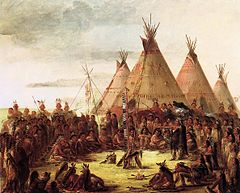
Tipis painted past George Catlin c. 1830
Western Indian Territory is part of the Southern Plains and is the ancestral habitation of the Wichita people, a Plains tribe. Additional indigenous peoples of the Plains entered Indian Territory during the equus caballus culture era. Prior to adoption of the horse, some Plains Indian tribes were agrarian and others were hunter-gatherers. Some tribes used the dog equally a draft animal to pull pocket-sized travois (or sleighs) to assistance motion from place to identify; even so, by the 18th century, many Southern Plains tribes adopted the horse culture and became nomadic. The tipi, an animal hide society, was used by Plains Indians every bit a home because they were portable and could exist reconstructed speedily when the tribe settled in a new expanse for hunting or ceremonies.
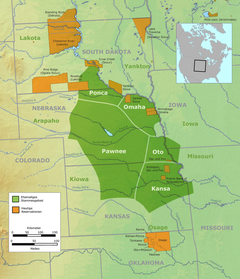
Plains Indians at fourth dimension of European contact and current homelands.
Historically, the Arapaho had assisted the Cheyenne and Lakota people in driving the Kiowa and Comanche south from the Northern Plains, their hunting area ranged from Montana to Texas. Kiowa and Comanche controlled a vast expanse of territory from the Arkansas River to the Brazos River. By 1840 many plains tribes had made peace with each other and developed Plains Indian Sign Linguistic communication every bit a means of communicate with their allies.
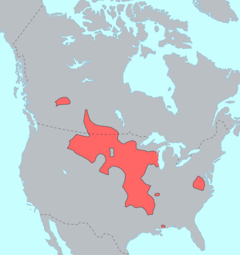
Pre-contact distribution of the Western Siouan languages
- The Kaw speak one of the Siouan languages and were originally from the Kansas area (with Kansas being derived from the proper noun of the tribe.) The Kaw are closely related to the Osage Nation and Ponca tribes (who kickoff settled in Nebraska), beingness from the aforementioned tribe before migrating from the Ohio valley in the mid-17th century. On June four, 1873, the Kaw removed themselves from Kansas to an surface area that would become Kay County, Oklahoma, tribal headquarters is in Kaw City, Oklahoma.
- The Ponca speak 1 of the Siouan languages and are closely related to the Osage Nation and Kaw tribes. The Ponca tribe were never at war with the United states and signed the first peace treaty in 1817.[33] In 1858 the Ponca signed a treaty, ceding function of their land to the United States in return for annuities, payment of $1.25 per acre from settlers, protection from hostile tribes and a permanent reservation home on the Niobrara River at the confluence with the Missouri River.[34] In the 1868 Usa-Sioux Treaty of Fort Laramie[35] the The states mistakenly included Ponca lands in present-day Nebraska in the Groovy Sioux Reservation of nowadays-day South Dakota. Disharmonize betwixt the Ponca and the Sioux/Lakota, who now claimed the state every bit their own by U.s. constabulary, forced the US to remove the Ponca from their own ancestral lands to Indian Territory in 1877, parts of the current Kay and Noble counties in Oklahoma. The country proved to be less than desirable for agriculture and many of the tribe moved back to Nebraska. In 1881, the US returned 26,236 acres (106.17 kmii) of Knox County, Nebraska, to the Ponca, and about half the tribe moved back due north from Indian Territory. Today, the Ponca Tribe of Indians of Oklahoma have their headquarters in Ponca City, Oklahoma.
- The Otoe-Missouria Tribe of Indians, speak one of the Siouan languages and carve up away from the Ho-Chunk in Wisconsin prior to European contact. The tribe is made up of Otoe and Missouria Indians, is located in part of Noble County, Oklahoma with tribal offices in Red Rock, Oklahoma. Both tribes originated in the Great Lakes region past the 16th century had settled near the Missouri and K Rivers in Missouri.[36]

Pre-contact distribution of Algonquian languages
- The Cheyenne and Arapaho Tribes of Oklahoma are a united tribe of the Southern Arapaho and the Southern Cheyenne people, headquartered in Concho, Oklahoma (a rural suburb of Oklahoma Metropolis.)
- The Cheyenne were originally an agrarian people in present-day Minnesota and speak an Algonquian language. In 1877, subsequently the Battle of the Little Bighorn (in present-day Montana) a group of Cheyenne were escorted to Indian Territory (present-day Oklahoma). However, they were not used to the dry estrus climate and nutrient was insufficient and of poor quality. A group of Cheyenne left the territory without permission to travel back n. Ultimately, the armed forces gave up attempting to relocate the Northern Cheyenne back to Oklahoma and a Northern Cheyenne reservation was established in Montana
- The Arapaho came from the present-mean solar day Saskatchewan, Montana, and Wyoming area, and speak an Algonquian language.

Pre-contact distribution of Northern Uto-Aztecan languages
- The Comanche lived in the upper Platte River in Wyoming breaking off from the Shoshone people in the late 17th century, and speak a Numic language of the Uto-Aztecan family. A nomadic people, the Comanche never developed the political idea of forming a single nation or tribe instead existing every bit multiple democratic bands. The Comanche (and other tribes) signed a treaty of friendship with the US in 1835.[27] An boosted treaty was signed in 1846.[26] In 1875, the last free band of Comanches, led by Quanah Parker, surrendered and moved to the Fort Sill reservation in Oklahoma. The Comanche Nation is headquartered in Lawton, Oklahoma.
- The Pawnee speak a Caddoan language. Originally from the surface area effectually Omaha, Nebraska. In the 16th century Francisco Vásquez de Coronado had an run across with a Pawnee chief. In the 1830s exposure to infectious diseases, such as measles, smallpox and cholera decimated the tribe. The 1857 Treaty with the Pawnee,[37] their range was reduced to an area around Nance County, Nebraska. In 1874 the tribe was relocated to land in the Cherokee Outlet in Oklahoma Territory, in Pawnee County, Oklahoma. Tribal Headquarters are in Pawnee, Oklahoma.
- The Tonkawa speak a language isolate, that is a language with no known related languages. The Tonkawa seem to have inhabited northeastern Oklahoma in the 15th century. Still, by the 18th century the Plains Apache had pushed the Tonkawa s to what is now southern Texas. Afterwards Texas was admitted as a State, the Tonkawa signed the 1846 Treaty with the Comanche and other Tribes at Council Springs, Texas.[26] After siding with the Confederacy, acting equally scouts for the Texas Rangers, the Tonkawa Massacre, occurring near Lawton, Oklahoma, killed well-nigh half of the tribe. In 1891 the Tonkawa were offered allotments in the Cherokee Outlet nigh nowadays-day Tonkawa, Oklahoma.
- The Kiowa originated in the expanse of Glacier National Park, Montana and speak a Kiowa-Tanoan linguistic communication. In the 18th century the Kiowa and Plains Apache moved to the plains adjacent to the Arkansas River in Colorado and Kansas and the Red River of the Texas Panhandle and Oklahoma. In 1837 the Kiowa (and other tribes) signed a treaty of friendship with the Usa that established a framework for legal system administered by the Usa. Provided for merchandise between Republics of Mexico and Texas.[38] Tribal headquarters are in Carnegie, Oklahoma
- The Plains Apache or "Kiowa Apache", a co-operative of the Apache that lived in the upper Missouri River area and speak i of the Southern Athabaskan languages. In the 18th century, the branch migrated due south and adopted the lifestyle of the Kiowa. Tribal headquarters are in Anadarko, Oklahoma.
- The Osage Nation speak one of the Siouan languages and originated in present-day Kentucky. As the Iroquois moved s, the Osage moved west. By the early on 18th century the Osage had become the dominant power in the Oklahoma, Arkansas, Missouri and Kansas, decision-making much of the country between the Ruddy River and Missouri River. From 1818 to 1825 a serial of treaties reduced the Osage lands to Independence, Kansas. With the 1870 Drum Creek Treaty, the Kansas land was sold for $1.25 per acre and the Osage purchased 1,470,000 acres (5,900 km2) in Indian Territory's Cherokee Outlet, the current Osage County, Oklahoma. While the Osage did non escape the federal policy of allotting communal tribal land to individual tribal members, they negotiated to retain communal mineral rights to the reservation lands. These were later constitute to have crude oil, from which tribal members benefited from royalty revenues from oil evolution and production. Tribal headquarters are in Pawhuska, Oklahoma.
Plateau tribes [edit]
After the Modoc War from 1872 to 1873, Modoc people were forced from their homelands in southern Oregon and northern California to settle at the Quapaw Agency, Indian Territory. The federal government permitted some to return to Oregon in 1909. Those that remained in Oklahoma became the Modoc Tribe of Oklahoma.[39]
The Nez Perce, a Plateau tribe from Washington and Idaho, were sent to Indian Territory every bit prisoners of war in 1878, but after groovy losses in their numbers due to disease,drought and dearth, they returned to their northwestern homelands in 1885.[40]
Government [edit]
During the Reconstruction Era, when the size of Indian Territory was reduced, the renegotiated treaties with the V Civilized Tribes and the tribes occupying the land of the Quapaw Indian Agency contained provisions for a government structure in Indian Territory. Replacement treaties signed in 1866 independent provisions for:[17]
- Indian Territory Legislature would take proportional representation from tribes over 500 members
- Laws take effect unless suspended by Secretary of the Interior or President of the United States
- No laws shall be inconsistent with the United States Constitution, or laws of Congress, or treaties of the The states
- No legislation regarding "matters pertaining to the legislative, judicial, or other organization, laws, or community of the several tribes or nations, except as herein provided for"
- Superintendent of Indian Diplomacy (or appointee) is the presiding officer of the Indian Territory Legislature
- Secretary of Interior appoints secretary of the Indian Territory Legislature
- A court or courts may be established in Indian Territory with such jurisdiction and arrangement every bit Congress may prescribe: "Provided that the same shall not interfere with the local judiciary of either of said nations."
- No session in any ane year shall exceed the term of thirty days, and provided that the special sessions may exist called whenever, in the judgment of the Secretarial assistant of the Interior, the interests of said tribes shall require it
In a continuation of the new policy, the 1890 Oklahoma organic act extended civil and criminal laws of Arkansas over the Indian Territory,[41] and extended the laws of Nebraska over Oklahoma Territory.[42]
See also [edit]
- Historic regions of the United States
- Missouri Compromise
- Parallel 36°30' north
- Territorial evolution of the Usa
- Territories of Spain that encompassed country that would later become role of Indian Territory:
- Tejas, 1690–1821
- Luisiana, 1764–1803
- U.Southward. territories that encompassed state that would later become part of Indian Territory:
- District of Louisiana, 1804–1805
- Territory of Louisiana, 1805–1812
- Territories of Spain that encompassed country that would later become role of Indian Territory:
- List of federally recognized tribes by state and List of federally recognized tribes alphabetic
- Native American tribes in Iowa
- Treaties
- Treaty of Fort Clark with the Osage.
- Osage Treaty (1825)
- Cherokee Commission
- Northwest Indian War the battle for Ohio
- Onetime Indian Reservations in Oklahoma
References [edit]
- ^ Everett, Dianna. "Indian Territory Archived 2012-02-25 at the Wayback Machine," Encyclopedia of Oklahoma History and Culture, published past the Oklahoma Historical Social club (accessed October 17, 2013).
- ^ Pennington, William D. Encyclopedia of Oklahoma History and Culture. "Reconstruction Treaties." Retrieved February 16, 2012.[1] Archived 2014-02-xx at the Wayback Car
- ^ "ACQUISITION OF THE PUBLIC DOMAIN, 1781–1867, Table 1.ane" (PDF). Archived from the original (PDF) on July 23, 2011. Retrieved 2012-03-02 .
- ^ a b "Downes v. Bidwell, 182 U.Southward. 244 (1901)". Retrieved 2012-03-02 .
- ^ "Encyclopedia of Arkansas". Encyclopedia of Arkansas . Retrieved 2020-07-09 .
- ^ Stein, Marking, 1951- (27 May 2008). How the states got their shapes (Starting time ed.). New York. ISBN978-0-06-143138-8. OCLC 137324984.
{{cite book}}: CS1 maint: multiple names: authors listing (link) - ^ a b "Everett, Dianna. Encyclopedia of Oklahoma History and Civilisation. "Indian Territory."". Archived from the original on 2012-02-25. Retrieved 2012-02-15 .
- ^ "SUBCHAPTER I - TREATIES". 25 USC Affiliate 3 - AGREEMENTS WITH INDIANS. uscode - business firm.gov. Archived from the original on March 17, 2012. Retrieved 27 February 2011.
- ^ 25 U.Due south.C. § 71. Indian Appropriation Deed of March 3, 1871, sixteen Stat. 544, 566
- ^ Congress' plenary authority to "override treaty provisions and legislate for the protection of the Native Americans." Usa v. Metropolis of McAlester, 604 F.2d 42, 47 (tenth Cir. 1979)
- ^ United states v. Blackfeet Tribe of Blackfeet Indian Reservation, 364 F.Supp. 192, 194 (D.Mont. 1973) ("[A]n Indian tribe is sovereign to the extent that the United States permits information technology to exist sovereign – neither more nor less.")
- ^ "The states v. Kagama, 118 U.Southward. 375 (1886), Filed May x, 1886". Retrieved 2012-04-29 .
- ^ "United states of america v. Kagama – 118 U.S. 375 (1886)". Retrieved 2012-04-29 .
- ^ "Act of Congress, R.S. Sec. 2080 derived from deed July five, 1862, ch. 135, Sec. 1, 12 Stat. 528". Archived from the original on March 17, 2012. Retrieved 2012-02-07 .
- ^ "Abrogation of treaties (25 USC Sec. 72) Codification R.South. Sec. 2080 derived from deed July 5, 1862, ch. 135, Sec. 1, 12 Stat. 528". Archived from the original on March 17, 2012. Retrieved 2012-02-07 .
- ^ Pennington, William D. Encyclopedia of Oklahoma History and Culture. "Reconstruction Treaties." Retrieved February xvi, 2012. [2] Archived 2014-02-20 at the Wayback Machine
- ^ a b "Treaty of Washington United states-Choctaw Nation-Chickasaw Nation, 14 Stat. 769, signed April 28, 1866". Archived from the original on February sixteen, 2012. Retrieved March 3, 2012.
- ^ Treaty of Dancing Rabbit Creek: Hearings on H.R. 19213 Before the H. Subcomm. on Indian Affairs, at 24 (February fourteen, 1912) (statement of Hon. Byron P. Harrison) ("While the {1866 Treaty of Washington} contemplated the firsthand allotment in severalty of the lands in the Choctaw-Chickasaw country, nonetheless such allotment in severalty to anyone was never made nether such treaty, and has just been consummated since the breaking up of the tribal organization and preparatory to the organization of the Land of Oklahoma.")
- ^ "Treaty with the Kiowa and Comanche, 1867 (15 Stats., 581) (Medicine Guild Treaty #one)". Archived from the original on 2011-eleven-26.
- ^ "Treaty with the Kiowa, Comanche, and Apache, 1867" (Medicine Lodge Treaty #2), (15 Stats. 589)". Retrieved 2012-02-29 .
- ^ "Treaty with the Cheyenne and Arapaho, 1867" (Medicine Lodge Treaty #3), (fifteen Stats. 593)". Archived from the original on 2009-06-29. Retrieved 2012-02-29 .
- ^ Forstall, Richard L. (ed.). Population of the States and Counties of the United States: 1790–1990 (PDF) (Report). United States Census Bureau. p. 132. Retrieved May 18, 2020.
- ^ "Enabling Act (Oklahoma) Public Constabulary 234, HR 12797, Jun 16, 1906 (59th Congress, Session one, chapter 3335". Archived from the original on March iii, 2016. Retrieved 2012-01-thirty .
- ^ Schlesier, Karl H. Plains Indians, 500–1500 CE: The Archaeological Past of Celebrated Groups. Norman: University of Oklahoma Printing, 1994: 347–348.
- ^ "TREATY WITH THE CADDO, July 1, 1835 (7 Stat., 470)". Archived from the original on 2012-02-17. Retrieved 2012-03-01 .
- ^ a b c "Treaty with the Comanche, Aionai, Anadarko, Caddo, etc., Wacoes, Keeches, Tonkaways, Wichetas, Towa-KarroesMay fifteen, 1846, (9 Stat., 844). The treaty established the US as a protectorate of the tribes and established legal procedures betwixt tribes and the US, Signed at Council Springs, Texas". Archived from the original on June 15, 2010. Retrieved 2012-03-01 .
- ^ a b "TREATY WITH THE COMANCHE, ETC., Aug. 24, 1835. (7 Stat., 474) Treaty of Friendship betwixt The states and Comanche and Witchetaw nations, and Cherokee Muscogee, Choctaw, Osage, Seneca and Quapaw and established framework for legal system supervised by US. Signed on the eastern border of the Grand Prairie, near the Canadian river, in the Muscogee nation". Archived from the original on 2012-02-fifteen. Retrieved 2012-03-02 .
- ^ Moser, George W. A Brief History of Cherokee Club #10 (retrieved 26 June 2009).
- ^ Burt, Jesse; Ferguson, Bob (1973). "The Removal". Indians of the Southeast: And then and Now. Nashville and New York: Abingdon Press. pp. 170–173. ISBN978-0-687-18793-5.
- ^ "1833 Treaty with the Chippewa, etc". Retrieved 2012-02-29 .
- ^ "Treaty of Washington with the Potawatomi 1867". Archived from the original on 2012-03-24. Retrieved 2012-02-29 .
- ^ Roberson, Glen (2009). "Peoria". The Encyclopedia of Oklahoma History and Culture . Retrieved 21 December 2017.
- ^ "1817 Ponca Treaty with the The states". Archived from the original on 2012-01-14. Retrieved 2012-03-01 .
- ^ "1858 Ponca Treaty with the US". Archived from the original on 2015-02-13. Retrieved 2012-03-01 .
- ^ "US-Sioux Treaty of 1868". Archived from the original on 2011-11-26. Retrieved 2011-xi-04 .
- ^ "May, John D. Otoe-Missouria. Oklahoma Historical Society's Encyclopedia of Oklahoma History & Culture" . Archived from the original on 2010-07-twenty. Retrieved 2012-03-01 .
- ^ "1957 Treaty with the Pawnee". Archived from the original on 2012-02-16. Retrieved 2012-03-01 .
- ^ "TREATY WITH THE KIOWA, ETC, May 26, 1837 (7 Stat. 533). Treaty of friendship between US and Kioway, Ka-ta-ka, and Ta-wa-ka-ro nations and Comanche, Witchetaw, Cherokee Muscogee, Choctaw, Osage, Seneca and Quapaw nations or tribes of Indians and provided for trade between Republics of Texas and Mexico, signed at Fort Gibson, Oklahoma". Archived from the original on May 30, 2017. Retrieved 2012-03-02 .
- ^ Self, Burl Eastward. "Modoc". Encyclopedia of Oklahoma History and Culture. Oklahoma Historical Lodge. Retrieved 20 December 2017.
- ^ Westmoreland, Ingrid. "Nez Perce". Encyclopedia of Oklahoma History and Culture. Retrieved 20 December 2017.
- ^ 26 Stat. 81, at 94-97
- ^ "Organic Deed, 1890, Oklahoma Historical Order's Encyclopedia of Oklahoma History". Archived from the original on 2011-07-26. Retrieved 2012-01-30 .
Further reading [edit]
- Clampitt, Bradley R. The Civil War and Reconstruction in Indian Territory (University of Nebraska Press, 2015). viii, 192 pp.
- Confer, Clarissa W. The Cherokee Nation in the Civil War (University of Oklahoma Printing, 2007)
- Gibson, Arrell Morgan. "Native Americans and the Civil War," American Indian Quarterly (1985), 9#4, pp. 385–410 in JSTOR
- Minges, Patrick. Slavery in the Cherokee Nation: The Keetowah Society and the Defining of a People, 1855–1867 (Routledge, 2003)
- Reese, Linda Williams. Trail Sisters: Freedwomen in Indian Territory, 1850–1890 (Texas Tech Academy Press; 2013), 186 pages; STUDIES black women held as slaves by the Cherokee, Choctaw, and other Indians
- Smith, Troy. "The Civil War Comes to Indian Territory", Civil State of war History (September 2013), 59#iii, pp. 279–319 online
- Wickett, Murray R. Contested Territory: Whites, Native Americans and African Americans in Oklahoma, 1865–1907 (Louisiana State Academy Printing, 2000)
Principal sources [edit]
- Edwards, Whit. "The Prairie Was on Burn": Eyewitness Accounts of the Ceremonious War in the Indian Territory (Oklahoma Historical Society, 2001)
External links [edit]
- Twin Territories: Oklahoma Territory – Indian Territory
- Encyclopedia of Oklahoma History and Civilization – Indian Territory
- High resolution maps and other items at the National Athenaeum
- See 1890s photographs of Native Americans in Oklahoma Indian Territory hosted by the Portal to Texas History
- TREATIES Past TRIBE Name Vol. 2 (Treaties) in part. Compiled and edited by Charles J. Kappler. Washington: Government Printing Part, 1904
- Oklahoma Digital Maps Collection
- Hawes, J. W. (1879). . The American Cyclopædia.
- Peters, Gerhard; Woolley, John T. "Benjamin Harrison: "Declaration 295 - Sioux Nation of Indians," Feb x, 1890". The American Presidency Project. University of California - Santa Barbara. Retrieved 17 January 2016.
- Peters, Gerhard; Woolley, John T. "Benjamin Harrison: "Proclamation 298 - Extinguishing Indian Championship to Certain Lands," October 23, 1890". The American Presidency Projection. University of California - Santa Barbara. Retrieved 17 January 2016.
dominguezpedularave.blogspot.com
Source: https://en.wikipedia.org/wiki/Indian_Territory
0 Response to "Again What Was Found in the Area Set Aside for the Native People?"
Post a Comment