How to Take Temp on Baby Back Ribs
Brisket, pork butt, ribs. These are the holy trinity of BBQ, and with skillful reason. These collagen-rich cuts thrive in the low, smoky heat of the BBQ cooker, slowly melting into gelatin-infused, bark-encrusted savory treats. And in no other BBQ cut practice you get the bark-to-meat ratio that you lot practice with ribs: slabs of ribs, dry rubbed and spicy; whole racks of ribs, glazed with tangy-sweetness sauce; riblets for gnawing while yous pick at the last of your coleslaw. They are wonderful.

Rib temp: 190°-205°F (88°-96°C)
While ribs are decidedly a part of the barbecue pantheon, there is a division to be made in that location. Spare ribs—anything but spares to those who know!—are the athletic, good-looking, more muscular large brother in the rib family unit. Yet, you shouldn't overlook the tender, shorter, amiable piffling brother! Infant back ribs are ofttimes relegated to the realm of 'pop' food, thanks in large part to a certain jingle that I'k not going to mention. Since baby back ribs' introduction into fast-casual dining in 1997, some BBQ meisters have turned their noses upwards at this cut of meat; merely I'1000 here to tell you that there is all the same a place at the BBQ table for baby back ribs!
At home, I love infant dorsum ribs"—Meathead Goldwyn
While most BBQ organizations encourage the use of spare ribs for competition, baby back ribs are first-class for the dwelling house. In this article, we'll look at the thermal experience of baby back ribs on their way to competition-style results. We'll be using Smoking-Meat.com'due south guidelines for the meat and the dual-aqueduct Blazon-K thermocouple ThermaQ ® Blue to track the temperature through the cook.
Baby Back Ribs Background
Spare ribs vs. baby back ribs
The popularity that infant back ribs' do accept has been helped profoundly by their proper name, which sounds tender and succulent. The name suggests tenderness far better than the term "loin ribs" does—loin is not a 'pretty' discussion—and yet, that is precisely what they are. The loin lies along the convex side of the ribs. In fact, if you swallow bone-in pork chops, you are getting baby back ribs for the bone. Spare ribs, past comparing, are plant further down the sides of the grunter and are coated on the convex side with belly meat. They are part and parcel of the same construction only are from different sections of the whole.
As yous tin can run into, the 'back' in 'infant back' refers to their location, high upwards on the pig's dorsum. 'Infant' just comes from their smaller size—it has nix to practice with the age of the pig!
Cooking baby back ribs
And then what does their location on the hog mean for cooking baby backs? For i thing, they're withal ribs, and that means connective tissue. You tin can't but slap these babies on the grill and cook them to a food-safety 145°F (63°C) or they'll be tough as nails. Dull cooking will dissolve that collagen.
But what happens when yous cook things past 155°F (68°C)? That's right all the h2o in the muscle fibers is wrung out by the denaturing proteins. And when that newly-released water finds its mode to the surface of the meat it starts to evaporate and you lot get the infamous stall.
To overcome the stall, take a page from brisket cookery and wrap the ribs, this time with aluminum foil. Every pitmaster has their own technique, but about follow something along the lines of what Steven Raichlen calls the 3-two-1 method. This guideline for reaching the proper temperature ways cooking for about three hours without a wrap, then for two hours wrapped tightly in foil, then for another hour unwrapped again. Simply notation that this time structure isonly a guideline for achieving thermal processes. You lot demand to go the ribs into a collagen-melting temperature zone—above 170°F (77°C)—and keep them there long enough to tenderize.
You could just cook the ribs bare until they accomplish a temperature that indicates enough collagen has broken downwardly, but that takes a while. Wrapping them prevents evaporative cooling (the stall), allowing your ribs to become to temperatures where collagen melts even faster. By the fourth dimension your ribs attain 200°F (93°C), they should be tender plenty to eat. All the wrapping and unwrapping serves mostly to achieve a proper bawl and tospeed the journey to the proper temperature.
For baby backs, Jeff Phillips of Smoking-Meat.com calls for a shorter 5-hour version of this method, but the concept is the aforementioned: cooking them wrapped the whole fourth dimension would make the bark soggy and sad, only wrapping for only office of the cook yields tender, barky ribs that have spent enough time in the melting-temp zone.
So much for the rib meat: what near that thick layer of meat on peak of the baby backs? That is loin meat. Loin meat is, in essence, a pork ribeye and is susceptible to drying out. It is depression on collagen and also rather lean, and so cooking it to whatever temperature above 150°F (66°C) will overdo it. This is where baby backs accept a declining. It is tempting to get super-meaty baby back ribs with a thick layer of loin, but that meat is liable to overcook. Rather than looking for extra-meaty ribs, look for those that have a relatively sparse layer of loin meat. The transition layer from rib to loin has the connective tissue needed to rehydrate the meat during a longer melt.
Infant dorsum rib temperature
The ribs, every bit we've discussed, are full of collagen, and collagen dissolution is a function of both fourth dimension and temperature. This means that the way we arroyo a finishing temperature matters almost equally much as the temperature itself. Jeff Phillips recommends a rib temp of 195°F (91°C), right in line with ThermoWorks canonical rib temp of 190°-205°F (88°-96°C), but he proposes ii methods of arriving there, one of which will requite you fall-off-the-bone tender ribs, the other of which will get you a competition-style rib that can pass the bite test: This means the rib must be bitten into to get the meat off the bone, while a perfect seize with teeth mark must remain behind without whatever extra meat tearing abroad from the rib along with your seize with teeth. The meat must pull abroad hands from the os.
I'll show you how to get them equally tender as what you lot find in the restaurant if that'due south what you're after."—Jeff Phillips
For competition style, employ a timing formula of 3-1-1, three hours blank, 1 60 minutes wrapped, then i hr bare again. (Note, for autumn-off-the-os ribs—for those that prefer them that way—use 2-2-1. The longer time in the moist environment of the foil allows the collagen to interruption downward more quickly—in that location is more time without evaporative cooling!)
Towards the stop of the blank-ribs phase, you volition discover that the temperature increase starts to slow. That's the stall starting to happen. Wrap those ribs with foil to speed things back up.
Every bit shortly as the ribs are wrapped, their internal temperature volition start to climb over again, up to and beyond the recommended minimum of195°F (91°C). Once they are unwrapped once again, the meat temperature will actually drop as the water that has accumulated on the surface starts to evaporate. This means that the ribs will stay in the collagen-melt zone without more oestrus goinginto them.
Thermally speaking, it'southward a lot like the fox of using a cooler with wrapped ribs that are mostly cooked to permit them to finish "melting." The cooler-method is a great way to improve the texture of your meat, simply it wreaks havoc on your bark. By allowing evaporative cooling to occur in the smoker, we can achieve melty ribs that aren't overcooked and that have a craveable bark. Thermodynamics!
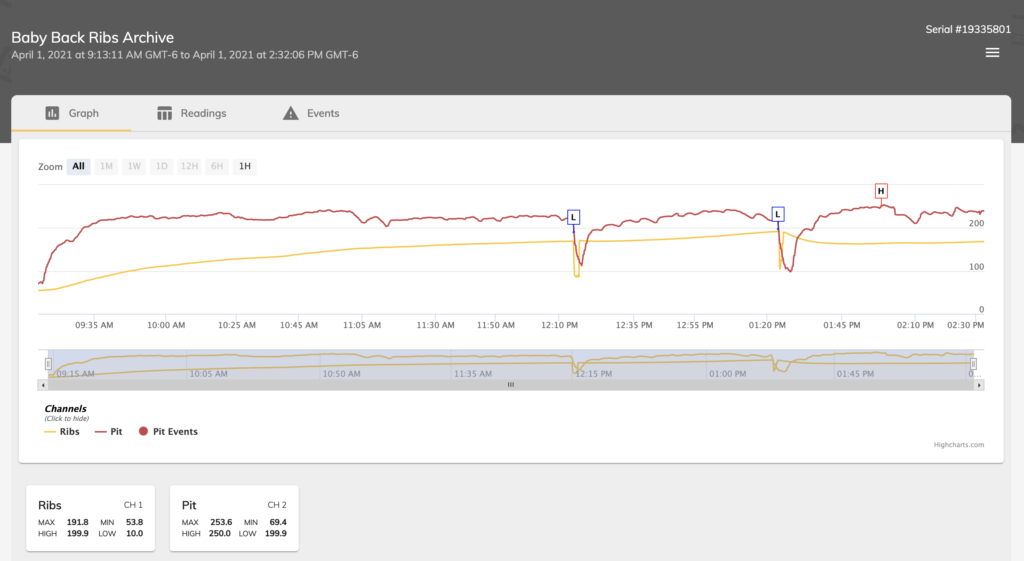
Below is a graph from the melt that we did, using the ThermaQ Bluish to monitor the temperatures. You can see the stall starting around 160°F (71°C). Then you tin can see the temp drop when we removed the probe for wrapping, afterwards which the temperature starts to climb much faster. When nosotros unwrap the ribs, the evaporative cooling takes over and the temperature dips, merely starts to recover before nosotros take them off the heat for skilful.
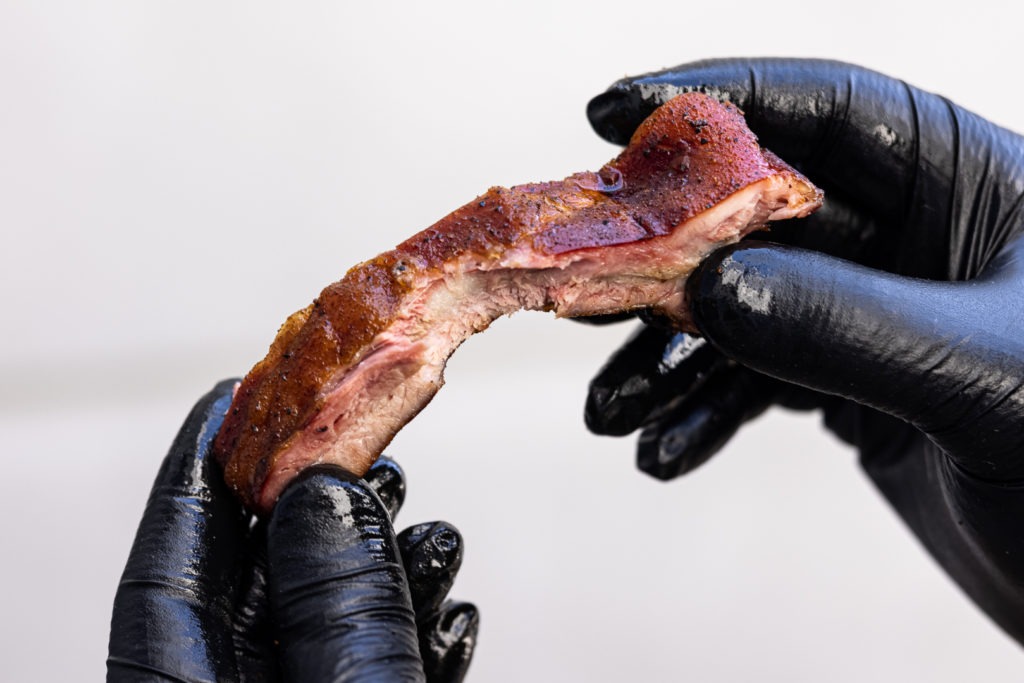
Baby dorsum ribs deserve their place in barbecue royalty. They are succulent, fun, and pretty easy to brand! Utilise a good thermometer like the ThermaQ Blue or a Thermapen 1 and remember the wrapping method: 2-2-1 for soft, three-1-1 for competition fashion. May is National Barbecue Month, and we hope that y'all'll give them a try!
- 1 rack, infant back ribs
- 3–4 Tbsp mustard
- Your favorite BBQ rub, as needed
- Your favorite BBQ sauce, optional
Special equipment: 2 large sheets of heavy-duty aluminum foil.
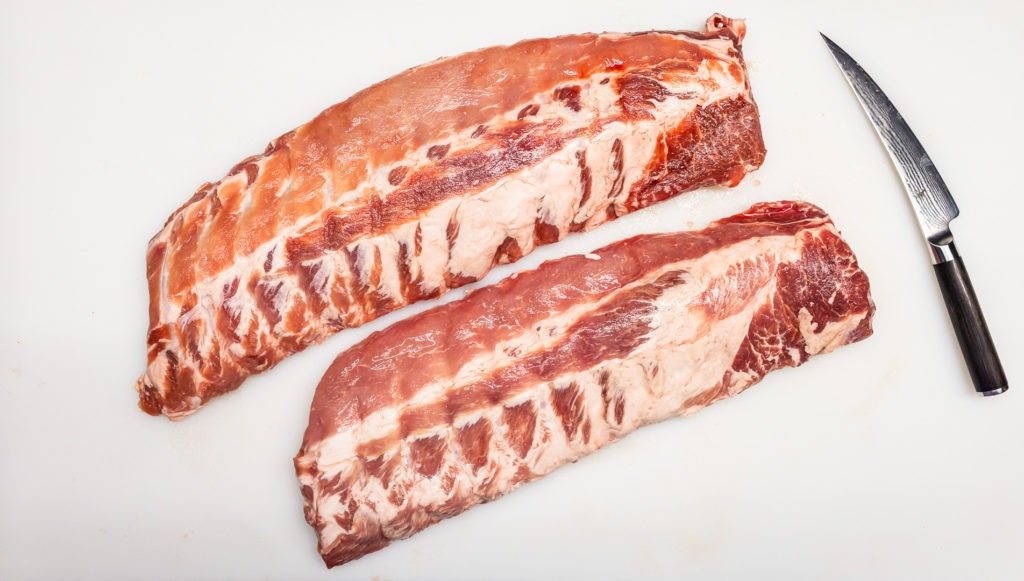
- Preheat your smoker to 220°-240°F (104°-116°C).
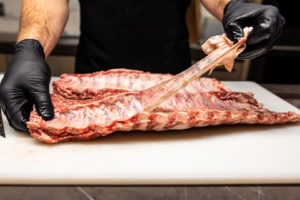
- Peel the membrane from the dorsum of the rack of ribs. This facilitates bawl product on the underside of the ribs, just is ultimately optional. (Or, yous tin ask your butcher to remove it for yous.)
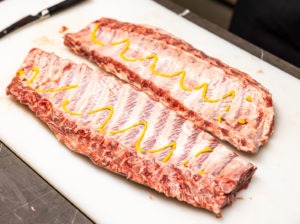
- Slather the ribs in mustard. (Jeff Phillips says this step is optional…I highly recommend it!)
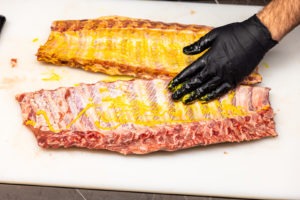
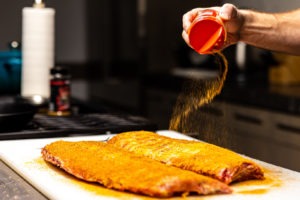
- Use rub generously to the ribs, pressing to help it adhere to the mustard.
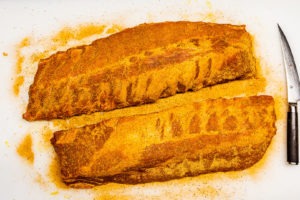
- Place ribs in the smoker. Insert a mini needle-probe into the ribs. Exercise this between the basic if the ribs take less meat or in the thickest role of the meat if they are very meaty. The needle probe is sparse enough to fit into the rib meat without touching bone.
- Gear up upwardly your ThermaQ Blueish to monitor the temperature.
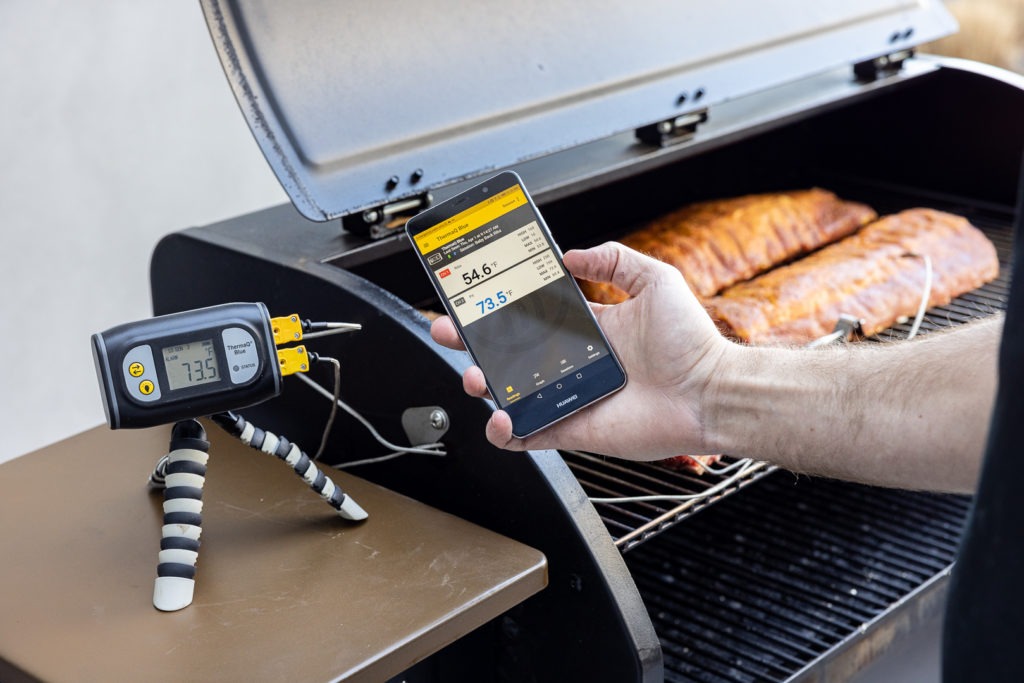
- Smoke the ribs for 3 hours for a contest-style finish, 2 hours for fall-off-the-bone ribs.
- When the time has expired, wrap the ribs well in aluminum foil. The temp should be somewhere near the 170°F mark.
- Render the baby back ribs to the smoker. Re-insert the probe.
- Fume for i hr (contest) or ii hours (fall-off).During this time, encounter that the ribs reach the target temp of190°-205°F (88°-96°C). (ready the high-temp alert on the ThermaQ Blue to let you know when y'all get there.)
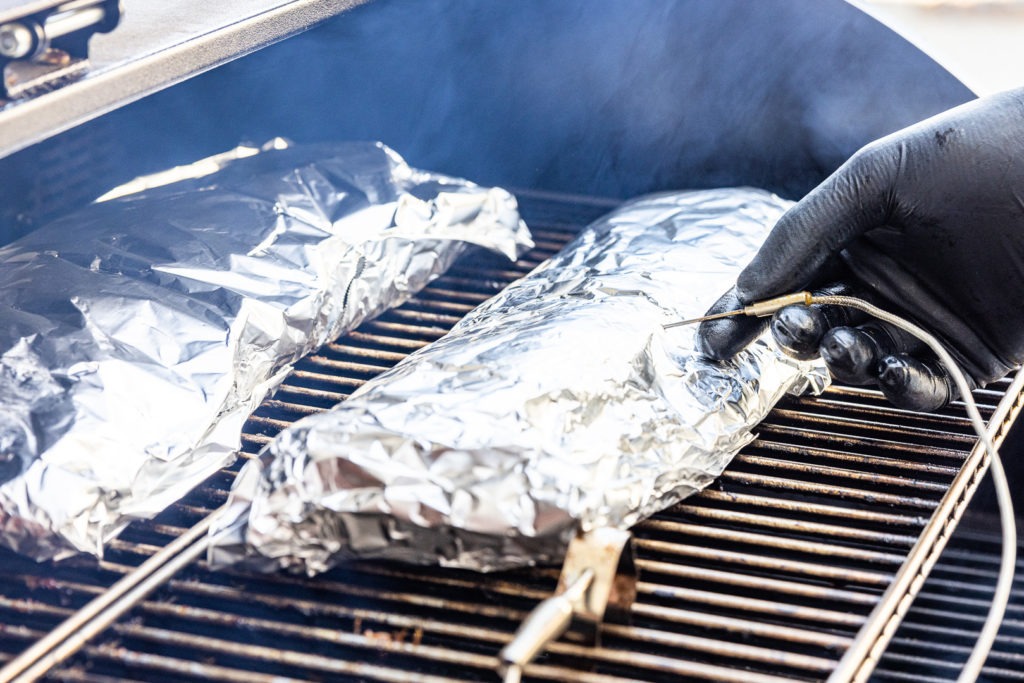
- Remove the ribs-package from rut and unwrap.
- If you want glazed, sticky ribs, now is the time to brush them with BBQ sauce. If you want to keep them "dry" but proceed from here.
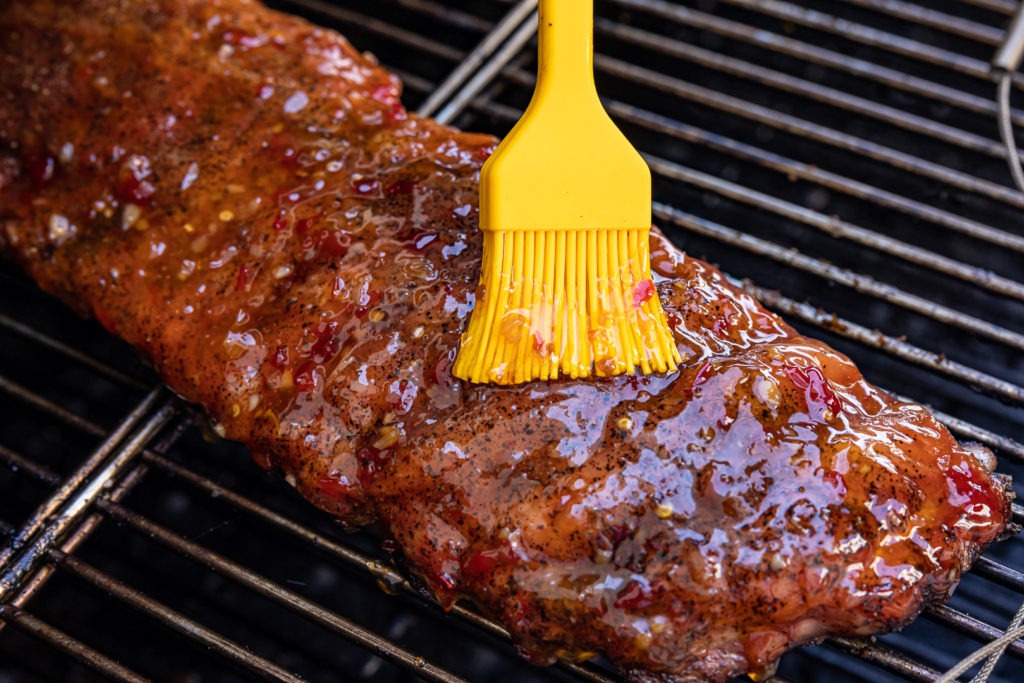
- Put the ribs back in the smoker. Replace the probe.
- Let the ribs to cook for 1 final hr. You volition see the temp drop during this time, then rise again somewhat.
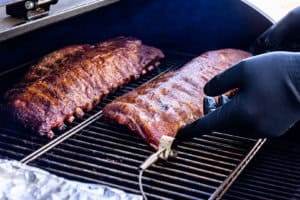
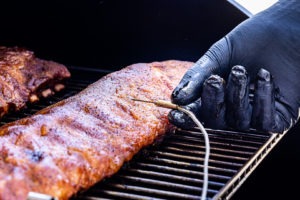
- Remove the ribs from heat. Allow cool enough to handle.
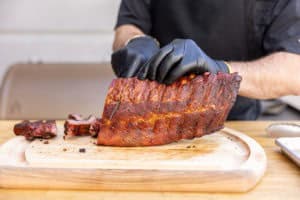
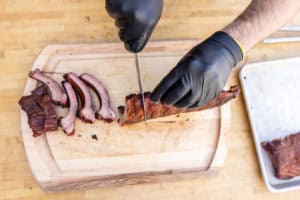
- Cut the ribs upwards and enjoy!
Store at present for products used in this mail:

dominguezpedularave.blogspot.com
Source: https://blog.thermoworks.com/pork/perfect-temp-smoked-baby-back-ribs-a-thermal-exploration/
0 Response to "How to Take Temp on Baby Back Ribs"
Post a Comment