what to do if your in a tsunami
Tsunamis are but long waves — actually long waves. But what is a wave? Sound waves, radio waves, even "the wave" in a stadium all have something in mutual with the waves that motion across oceans. It takes an external strength to showtime a wave, similar dropping a rock into a pond or waves blowing across the sea. In the case of tsunamis, the forces involved are large — and their furnishings tin be correspondingly massive.
What is a seismic sea wave?
A tsunami is a series of extremely long waves caused by a big and sudden displacement of the ocean, usually the result of an convulsion below or most the ocean flooring. This force creates waves that radiate outward in all directions away from their source, sometimes crossing entire ocean basins. Unlike wind-driven waves, which only travel through the topmost layer of the ocean, tsunamis motility through the entire water column, from the ocean flooring to the ocean surface.

In 1964, tsunamis devastated coastal communities in Alaska. Impacts were felt forth U.Due south. and Canadian west coasts and in Hawaii…
What causes tsunamis?
Near tsunamis are caused by earthquakes on converging tectonic plate boundaries. According to the Global Historical Tsunami Database, since 1900, over 80% of likely tsunamis were generated by earthquakes. However, tsunamis can likewise be acquired by landslides, volcanic activity, sure types of weather, and—perchance—near-globe objects (due east.chiliad., asteroids, comets) colliding with or exploding above the ocean.
Tsunami motion
Once a tsunami forms, its speed depends on the depth of the ocean. In the deep ocean, a tsunami can move as fast as a jet plane, over 500 mph, and its wavelength, the distance from crest to crest, may be hundreds of miles. Mariners at bounding main will not normally observe a tsunami as it passes below them; in deep water, the meridian of the wave rarely reaches more than than three feet higher than the body of water swell. NOAA Deep-sea Assessment and Reporting of Tsunami (Sprint) systems, located in the deep sea, are able to detect small changes in body of water-level height and transmit this information to tsunami warning centers.
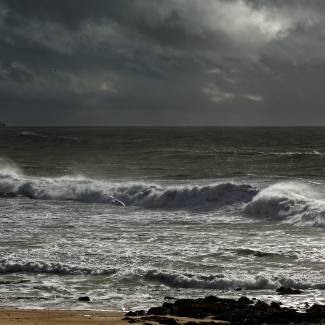
Driven by severe weather, these waves exacerbate flooding, erosion and can cause injury
Seismic sea wave rubber
A seismic sea wave simply becomes chancy when it approaches land. As a tsunami enters shallow water near coastal shorelines, it slows offsite link to 20 to thirty mph. The wavelength decreases, the height increases, and currents intensify.
Tsunami warnings come in dissimilar forms. There are official warnings issued by seismic sea wave warning centers that are broadcast through local radio and tv, wireless emergency alerts, NOAA Weather Radios, NOAA websites, and social media. They may also come through outdoor sirens, local officials, text message alerts, and phone notifications. There may not be time to wait for an official alarm, so it is important to be able to recognize natural tsunami warnings. These include strong or long earthquakes, a loud roar (like that of a train or an airplane) coming from the ocean, and a sudden ascent or fall of the sea level that is not related to the tide. Official and natural warnings are equally of import. Exist prepared to respond immediately to any seismic sea wave warnings. Motion quickly to a safe place by post-obit posted evacuation signs. If yous exercise not see an evacuation route, go to high ground or equally far inland every bit possible.
When they strike country, most tsunamis are less than ten feet high, simply in extreme cases, they tin can exceed 100 feet near their source. A tsunami may come up onshore like a fast-ascent flood or a wall of turbulent water, and a big tsunami tin overflowing low-lying coastal areas more than a mile inland.
Rushing water from waves, floods, and rivers is incredibly powerful. But vi inches of fast-moving water tin can knock adults off their anxiety, and twelve inches can carry away a pocket-size car. Tsunamis tin exist especially destructive because of their speed and volume. They are also dangerous as they return to the body of water, carrying debris and people with them. The starting time wave in a seismic sea wave may not be the last, the largest, or the most damaging. Stay out of the tsunami gamble zone until local officials tell yous it is rubber, equally the danger may final for hours or days.
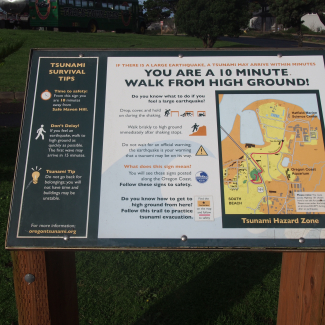
"We need to find a sweetness spot between fearfulness and action..."
Tsunami effects on humans
Big tsunamis are significant threats to human wellness, belongings, infrastructure, resource, and economies. Furnishings tin be long-lasting, and felt far across the coastline. Tsunamis typically cause the most severe damage and casualties near their source, where in that location is little time for alarm. Simply large tsunamis can as well achieve distant shorelines, causing widespread damage. The 2004 Indian Bounding main seismic sea wave, for case, impacted 17 countries in Southeastern and Southern Asia and Eastern and Southern Africa.
Tsunami forecasting
Scientists cannot predict when and where the next tsunami will strike. Just the seismic sea wave warning centers know which earthquakes are probable to generate tsunamis and can issue messages when one is possible. They monitor networks of deep-ocean and coastal sea-level ascertainment systems designed to observe tsunamis and use information from these networks to forecast coastal impacts and guide local decisions about evacuation. Seismic sea wave warning capabilities take become dramatically better since the 2004 Indian Ocean tsunami. NOAA scientists are working to farther improve warning center operations and to help communities be prepared to respond.

NOAA's tsunami warning capabilities have greatly improved since the 2004 Indian Ocean seismic sea wave...
Instruction CONNECTION
Students can investigate tsunamis to find the impacts of Earth's systems on humans. Teachers can utilise these potentially deadly waves and other natural hazards to bring relevance to science concepts such equally plate tectonics, acceleration and speed, force and motion, energy transfer, and the physics of waves. In addition, many schools, homes, and businesses are located in tsunami adventure zones offsite link. Many coastal states and territories accept seismic sea wave preparedness campaigns in place. Teaching students most seismic sea wave safety and preparedness plans may ultimately save lives.
dominguezpedularave.blogspot.com
Source: https://www.noaa.gov/education/resource-collections/ocean-coasts/tsunamis
0 Response to "what to do if your in a tsunami"
Post a Comment